Recommended setup and example dataset
Generally, ReMeta’s default configuration reflects our recommended setup. However, we strongly suggest considering a few additional tweaks.
Tweak 1: random effects modeling of metacognitive noise
Metacognitive noise is both a key parameter of ReMeta and among the most difficult to estimate reliably. This is particularly true for observers with moderate to high type 1 noise, because it is difficult to disentangle whether variability in confidence ratings reflects type 1 uncertainty or metacognitive noise.
To improve the robustness of metacognitive-noise inference, we recommend estimating metacognitive noise in a random-effects setup, where individual estimates are regularized by the overall group-level tendency.
cfg = remeta.Configuration()
cfg.param_type2_noise.group = 'random'
Note that this requires ReMeta to be fitted in “group mode”, i.e. passing all subject data at once to remetaObject.fit() (see Group parameters).
Tweak 2: linearize stimulus input
Because stimulus magnitude if often not available in interval scale, consider linearizing your stimulus input. See Stimulus evidence for details. To this aim either set
cfg.optim_type1_linearize = Trueor pass it to remetaObject.fit([...], linearize=True).
Tweak 3: grid search for type 2 parameters
Type 2 parameter estimation with gradien-based methods sometims does not find the global minimum, especially if there are are multple confidence criteria. We therefore recommended to use an initial gridsearch covering a sensible range of the parameter space:
cfg.optim_type2_gridsearch = TrueExample dataset
To illustrate the recommended usage of ReMeta, we use a dataset of 20 participants by Shekhar and Rahnev 1.
import pandas as pd
# The dataset can be found here:
# https://github.com/coconeuro/remeta/blob/main/remeta/demo_data/shekhar_2021_session1.csv
df = pd.read_csv('../data/shekhar_2021_session1.csv')df.head()The dataset has 20 participants and 800 trials per participant (overall there were 2800 trials, but this is only session 1 data):
df.groupby('subject').size().valuesarray([800, 800, 800, 800, 800, 800, 800, 800, 800, 800, 800, 800, 800,
800, 800, 800, 800, 800, 800, 800])There were three stimulus magnitude levels (difficulties) and confidence was a continuous variable between 0 and 1.
The goal is to fit ReMeta to all participants at once. We therefore create lists of (subject-level) lists for the variables stimuli, choices and confidence:
stimuli, choices, confidence = [df.groupby('subject')[col].apply(list).values for col in ('stimuli', 'choices', 'confidence')]We use the recommended tweaks above and fit the model. Moreover, as mentioned in the section # Type 2: the metacognitive stage, we recommend to fit confidence criteria even for continuous data. Below, we therefore pass n_ratings=4 to the fit method (implying 3 confidence criteria).
import remeta
cfg = remeta.Configuration()
cfg.param_type2_noise.group = 'random'
cfg.optim_type1_linearize = True
cfg.optim_type2_gridsearch = True
cfg.optim_num_cores = -1  # multiprocessing: -1 = use all cores except one
rem = remeta.ReMeta(cfg)
rem.fit(stimuli, choices, confidence, verbosity=0)  # Takes at least a few minutes
result = rem.summary()
Fitting of confidence criteria is enabled, but `n_ratings` was not passed. Using the default of 4 confidence ratings / 3 confidence criteria. To suppress this message, pass `n_ratings=X` to the `fit` method.
As noted by the message, by default ReMeta fits four confidence ratings (corresponding to 3 confidence criteria) − even if confidence ratings are continuous as in this case.
We can visualize the distribution of the parameters
import matplotlib.pyplot as plt
plt.figure(figsize=(10, 6))
for i, param in enumerate(['type1_bias', 'type1_noise', 'type2_noise']):
    plt.subplot(2, 3, i + 1)
    plt.hist([p[param] for p in result.params])
    plt.title(param)
for i in range(3):
    plt.subplot(2, 3, i + 4)
    plt.hist([p['type2_criteria'][i] for p in result.params])
    plt.title(f'Criterion {i + 1}')
plt.tight_layout()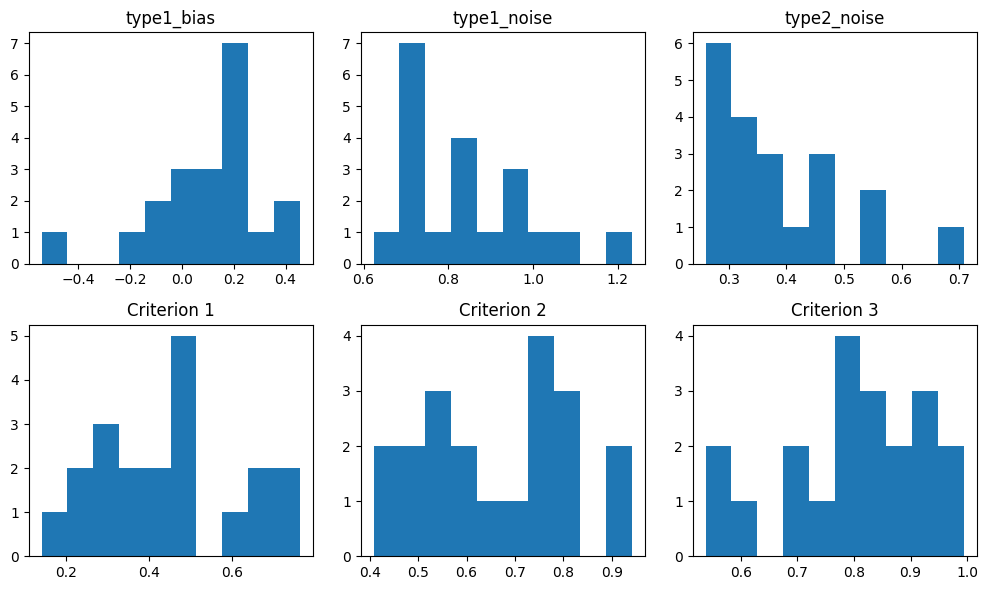
... and the confidence bias:
plt.figure(figsize=(3, 3))
plt.hist([p['type2_criteria_confidence_bias'] for p in result.params_extra])
plt.title('Confidence bias');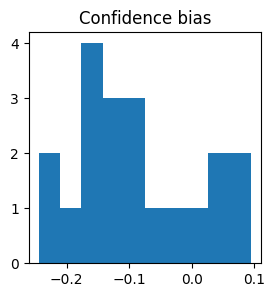
It is strongly recommended to validate the fitted parameters against some descriptive measures.
First, type 1 noise should correlate (negatively) with accuracy:
data_accuracy = [np.mean((np.array(stim) > 0) == np.array(dec, bool)) for stim, dec in zip(stimuli, choices)]
model_type1_noise = [p['type1_noise'] for p in result.params]
plt.figure(figsize=(3, 3))
plt.scatter(data_accuracy, model_type1_noise)
plt.xlabel('Accuracy (data)')
plt.ylabel('Type 1 noise (model)')
from scipy.stats import spearmanr
r, p = spearmanr(data_accuracy, model_type1_noise)
plt.text(0.97, 0.9, f'r={r:.3f} (p={p:.3f})', transform=plt.gca().transAxes, ha='right')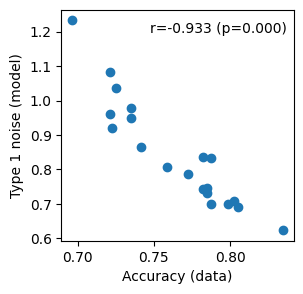
Second, type 2 noise should bear some relationship with how much average confidence differs between correct and incorrect choices (higher metacognitive noise -> less pronounced difference):
data_confidence_correct = [np.mean([c for i, c in enumerate(conf) if int(stim[i] > 0) == dec[i]]) for stim, dec, conf in zip(stimuli, choices, confidence)]
data_confidence_incorrect = [np.mean([c for i, c in enumerate(conf) if int(stim[i] > 0) != dec[i]]) for stim, dec, conf in zip(stimuli, choices, confidence)]
data_confidence_correct_m_incorrect = np.array(data_confidence_correct) - np.array(data_confidence_incorrect)
model_type2_noise = [p['type2_noise'] for p in result.params]
plt.figure(figsize=(3, 3))
plt.scatter(data_confidence_correct_m_incorrect, model_type2_noise)
plt.xlabel('Confidence correct – incorrect (data)')
plt.ylabel('Type 2 noise (model)')
r, p = spearmanr(data_confidence_correct_m_incorrect, model_type2_noise)
plt.text(0.97, 0.9, f'r={r:.3f} (p={p:.3f})', transform=plt.gca().transAxes, ha='right')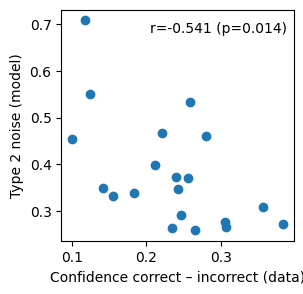
Third, the confidence bias should typically correlate positively with average confidence:
data_average_confidence = [np.mean(conf) for conf in confidence]
model_confidence_bias = [p['type2_criteria_confidence_bias'] for p in result.params_extra]
plt.figure(figsize=(3, 3))
plt.scatter(data_average_confidence, model_confidence_bias)
plt.xlabel('Average confidence (data)')
plt.ylabel('Confidence bias (model)')
r, p = spearmanr(data_average_confidence, model_confidence_bias)
plt.text(0.03, 0.9, f'r={r:.3f} (p={p:.3f})', transform=plt.gca().transAxes)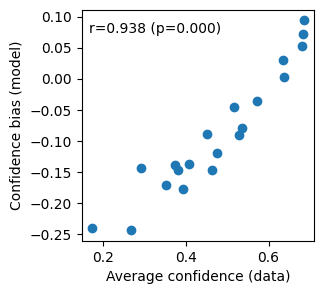
- Shekhar, M., & Rahnev, D. (2021). The nature of metacognitive inefficiency in perceptual decision making. Psychological Review, 128(1), 45–70. 10.1037/rev0000249