Stimulus evidence
ReMeta is designed to work with continuous stimulus magnitudes, corresponding to the absolute value of the stimuli variable passed to ReMeta’s fit methods.
An important assumption in this regard is that the stimulus magnitude encodes the amount of evidence available — in interval scale.
Evidence means that the stimulus magnitude is proportional to a signal-to-noise ratio. Since proportionality is sufficient, stimulus magnitude can also simply encode the “signal numerator” (e.g., offset angle from a reference, motion coherence in percent) IF the noise is not altered between different signal levels.
Interval scale means that 1) identical increments of the stimulus variable anywhere along the stimulus axis should correspond to identical increments in evidence; and 2), the value 0 should indicate the absence of any evidence.
If you are uncertain whether your stimuli conform to this requirement, ReMeta offers the method remeta.check_linearity().
# load `stimuli` and `choices`; optionally `difficulty_levels` if stimuli is
# categorical and the difficulty is available in a separatey array.

remeta.check_linearity(stimuli, choices[, difficulty_levels])
Below is an example of a dataset on which this method was evoked. Note that we pass the entire group’s data to check_linearity.
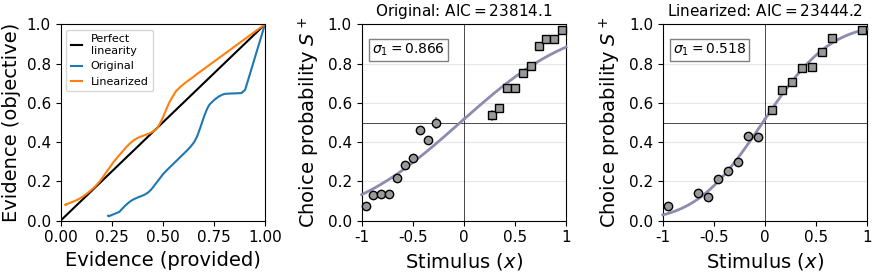
Linearization works by estimating type 1 noise () along the stimulus magnitude dimension while setting the “signal” to 1 in each case. The original stimuli are then transformed to a signed signal-to-noise ratio in the form .
The left panel shows the relationship between the originally provided stimulus evidence and objective stimulus evidence (blue line). The mismatch is quite evident in this example and a psychometric probit curve hardly fits the data (center panel).
After linearization, provided and objective evidence line up much better (orange line in the left panel) and the fit is visually and objectively better (right panel).
Note however, that the remeta.check_linearity() method uses – by default – a computationally cheap method to correct for linearity. To thoroughly linearize stimuli, use remeta.linearize_stimulus_evidence():
stimuli_linear = remeta.linearize_stimulus_evidence(stimuli, choices[, difficulty_levels])Again, we recommend to pass the entire group’s data to linearize_stimulus_evidence, either as a flat 1d array or as a n_subjects x n_trials 2d array. The default settings usually work fine – if not, check out the parameters of this method.
To control the success of linearization, pass the new stimuli variable again to remeta.check_linearity():
remeta.check_linearity(stimuli_linear, choices)Not that stimuli_linear now encodes stimulus category and magnitude and thus difficulty_levels are definitely not required.
In the example, this is the result:
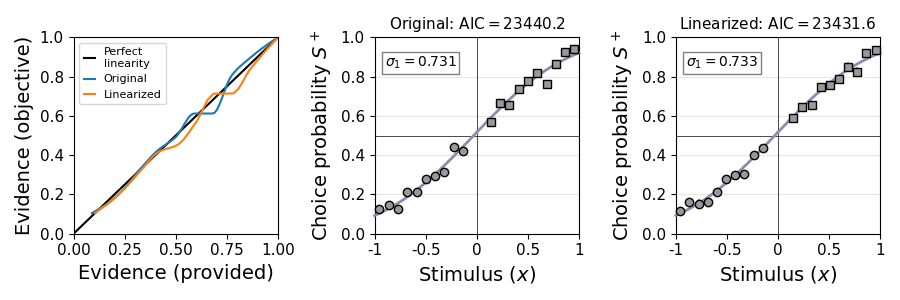
The stimuli variable is now almost perfectly linear. The model fit is even a bit better compared to the initial check above, because remeta.linearize_stimulus_evidence() transforms the magnitude axis (by default) with a computationally more elaborate method involving a rolling window.
Important note: Following such preprocessing, the single-subject AIC / BIC values of ReMeta models are not computed relative to the original raw data, but relative to some a transformation that has used up parameters (even if only a fraction of a parameter per participant).
The advantage of careful linearization – as outlined above – is that it likely improves parameter estimates across both the type 1 and type 2 stage. At the type 1 stage, / type1_noise now provides a single and robust estimate of an observer’s overall sensitivity, independent of stimulus difficulty levels. At the type 2 stage, forwarded type 1 decision values are more precise and provide a better basis for type 2 parameter inference.
It can be thus a trade-off between (likely) better parameter inference and AIC / BIC values that can be compared to other models. If you do care about model comparison, your options are to either i) do stimulus linearization based on an independent dataset (or pilot subjects / excluded subjects), ii) not use this linearization method and instead provide stimulus magnitude in a form that approximates a signal-to-noise ratio (using knowledge about the process of stimulus generation), or iii) just not care about linearization at all.
The alternative – adopted by most other models – is to estimate a sensitivity parameter for each participant and each difficulty level separately. While this allows for the computation of a clean per-participant likelihood, it comes with disadvantages:
Sensitivity estimated in this way conflates the difficulty of the stimulus and the specific sensitivity of the participant.
It requires enough samples per participant and difficulty level, as otherwise parameter fits become quickly unstable.
It is unclear how to fit these models if stimulus evidence is continuous and not restricted to a few discrete evidence levels.